


... discovering what the members of the community are doing and their outcomes...
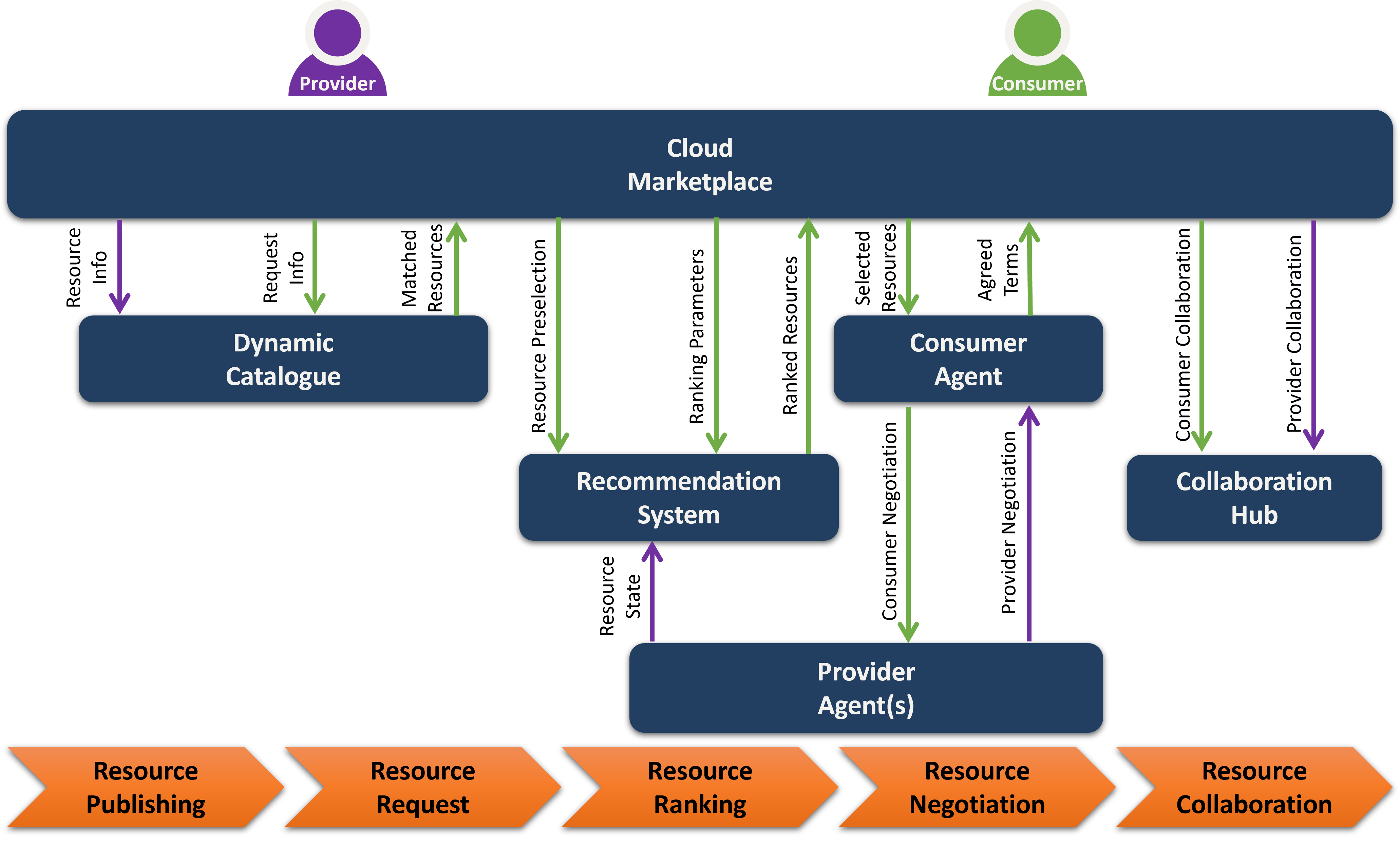
Manufacturing as a Service (MaaS) is a business model where Providers of manufacturing resources and Consumers of such resources interplay with one another within a business-to-business (B2B) ecosystem, aiming to establish a business relationship and exchange a service against a financial compensation. The interplay among these parties can benefit from a digital environment, supporting the Providers in showcasing their resources and assisting the Consumers in discovering the resources to fulfill their needs. The MaaSAI EU project aims to implement such a digital environment, featuring dedicated functionalities like dynamic catalogue, recommendation system, negotiating agents, and collaboration hub.
All these functionalities will be accessible from a cloud-based platform where the different parties will be guided according to the objective that they have in mind. The platform will offer different means for guidance: a) the user selects a preconfigured workflow and the platform automatically guides the user leveraging the specialized functionalities; b) the user autonomously navigates through the platform and utilizes the needed functionality; or c) the user defines a goal that is automatically decomposed into different actions, forming an agentic workflow where different functionalities (or expert systems) are progressively orchestrated until the desired goal is reached. This paper explores the challenges and technical requirements behind the implementation of an Agentic Platform for unlocking the potential behind MaaS.
Introduction
The innovation capacity of the European manufacturing industry is immense; nonetheless, its competitiveness is challenged by the constrained efficiency in the production processes, caused by the limited access to modern manufacturing equipment, to advanced digital solutions or to open collaborative environments. This is especially critical for manufacturing small- and medium-sized enterprises (SMEs), which represent 99% of the European manufacturing industry with over 2.1 million enterprises. Such constrained efficiency jeopardizes the resilience, employment and sustainability of the European manufacturing industry, accelerating the import of manufactured products from other regions in the world.
The MaaSAI EU project aims to tackle important obstacles faced by the European manufacturing industry, by facilitating the access to and utilization of manufacturing resources (like equipment, software solutions, human expertise) offered by distributed Providers across Europe. To do so, MaaSAI will establish a system where Providers of manufacturing resources and Consumers of such resources interplay with one another within a B2B ecosystem. This system will offer: a) common cloud-based specialized interface to assist Providers and Consumers of manufacturing resources in finding one another and negotiating the terms of the request; b) a tailor-made suite of tools for Providers to digitalize the shop floor and optimize the production of remote manufacturing requests; and c) a dedicated set of tools for Consumers to monitor the remote manufacturing request and to simulate their own manufacturing processes according to the remote capacities.
Proposed Agentic Platform
The proposed Agentic Platform is a cloud-based environment and the main entry point for the MaaSAI System, facilitating the technical and business interplay among Providers and Consumers in the context of Manufacturing-as-a-Services actions. Providers will be able to servitize access to their own manufacturing resources (e.g. equipment, data, software, etc.). Consumers will be able to complement their manufacturing capabilities and capacities by accessing manufacturing resources offered by distributed Providers. The proposed Agentic Platform is composed of different expert solutions: a) Cloud Marketplace, b) Dynamic Catalogue, c) Recommendation System, d) Negotiating Agents, and e) Collaboration Hub. The Figure above depicts the communication flow of the experts solutions across the MaaS life cycle, outlined by: 1) resource publishing (for Providers), 2) resource request (for Consumers), 3) resource ranking (for Consumers), 4) resource negotiation (for Providers and Consumers), and 5) resource collaboration (for Providers and Consumers).
Cloud Marketplace: The Cloud Marketplace aims to facilitate the access to manufacturing resources offered as services by distributed Providers. The Marketplace leverages manifold ICT solutions that enable the technical and business interplay among Providers and Consumers. The objectives of the Marketplace are: 1) streamline the onboarding process for stakeholders, by finding ways to facilitate the discovery of the services from the perspective of the stakeholder and not from the perspective of the technology; 2) develop a flexible mechanism that presents tailored interfaces depending on the stakeholder profile and avoids vendor lock-in and oversimplification; 3) boost the decision-making process for stakeholders and facilitate the exchange among the stakeholders; and 4) conceive an agentic workflow that interacts with independent expert solutions. The agentic workflow will be equipped with modules for: perception, planning, execution, learning, memorizing, and tool integration. The Deep Agents library built on top of LangChain is being evaluated as the basis for realizing the agentic workflow. The Cloud Marketplace will interplay with the Dynamic Catalogue, the Recommendation System, the Negotiating Agents, and the Collaboration Hub; these solutions will act as expert “agents” for the agentic workflow.
Dynamic Catalogue: The Dynamic Catalogue facilitates the description of the manufacturing resources of the Providers, by leveraging appropriate ontologies (e.g. MASON, ADACOR, InPro, OPC UA, ISO 10303 STEP) and ensuring adequate representation of the body of knowledge of the resources. The Dynamic Catalogue enables searchability and discovery of available resources, data management and knowledge. The main objectives are: 1) facilitate the description of assets and services within the MaaS ecosystem by Providers; 2) enable Consumers to search and discover available Providers and services according to their needs; 3) suggest the most suitable and optimal services based on user needs and available offerings; and 4) constantly update the information about the resources through the ontology model.
Recommendation System: The Recommendation System is a component designed to intelligently match manufacturing needs (from Consumers) with available resources (of Providers) within a MaaS ecosystem. The Recommendation System will dynamically analyze and synthesize data from multiple sources, using different algorithms, including Machine Learning (ML) models and Explainable AI (XAI) to provide actionable recommendations. The Recommendation System will assist Consumers in analyzing their needs and matching them with the most suitable resources from Providers based on user-defined criteria. The Recommendation System aims to achieve: 1) dynamic resource matching, 2) enhanced efficiency; 3) sustainability and circularity; and 4) scalability and agility. Additionally, the Recommendation System will be enriched with physics-based models to provide insightful matches by understanding the underlying material properties and behaviors.
Negotiating Agents: The Negotiating Agents are specialized AI-enabled solutions (based on SPADE) that will represent the individual interests of Providers and Consumers in the context of a manufacturing order request. The Consumer Agent will represent the Consumer with the specified order request and some parameters or criteria relevant for the negotiation. The Provider Agent will represent the Provider with the available capabilities and capacities and the current constraints and commitments within the factory. Both Agents will interact with one another (via FIPA-ACL and MQTT), aiming to outline the details of the negotiation terms (e.g. price, deadline, quality, sustainability) that both Provider and Consumer could agree to. Each Agent will rely on specialized autonomous evaluation algorithms to formulate offers and counteroffers, leveraging Explainable AI to enhance transparency and clarity in communication.
Collaboration Hub: The Collaboration Hub is a component conceived to support the seamless collaboration between Providers and Consumers. The Collaboration Hub enhances accessibility, making communication and collaboration between Providers and Consumers more efficient, convenient, and user-friendly. The main functionalities of the Collaboration Hub are: 1) secure messaging with dedicated portal for seamless communication between providers and consumers; 2) file sharing for streamlining the exchange, location and retrieval of files at any time; 3) virtual meetings for easy scheduling and hosting virtual communication within the same platform; and 4) task management to enhance transparency by keeping both Providers and Consumers fully informed of task states and progress in real time.
Evaluation Plan
The proposed Agentic Platform aims to facilitate access to manufacturing resources as services offered by distributed providers. To this end, the platform will feature flexible and tailored interfaces that will adapt to the scope, context, and the organization and its role, accounting for finding and viewing the same content from different perspectives. The user will define a goal, and a set of questions and options will be presented to customize the workflow journey. The platform will guide the user through the steps and touch points required to achieve the defined goal, while orchestrating the interplay with other expert solutions. To measure the workflow performance, relevant metrics will be considered: a) workflow durations, b) success rate, c) throughput, d) mean time to recovery, and e) error rate. The metrics will be measured by adopting a measurement framework to collect relevant data points in a regular and structured manner. The evaluation criteria will rely on the assessment of the current processes without the use of the proposed Agentic Platform, providing the baseline to compare the collected data points with. A scoring methodology will be outlined, which would allow mapping measured data points to actionable scores, guiding the decision-making and easing the identification of optimization strategies (e.g. automation of repetitive tasks or standardization of operations).
Outlook
Manufacturing as a Service renders significant potential for the manufacturing industry, especially for SMEs. Nonetheless, such a potential can only be unlocked with specialized digital solutions that efficiently simplify the complexity behind exposing manufacturing resources, capturing manufacturing order requests, matching requirements and needs with capabilities and capacities, agreeing terms and conditions, and collaborating during the production. The Agentic Platform proposed by the MaaSAI EU project leverages specialized solutions for every single step, tackling the individual complexities; however, putting all together still can overwhelm stakeholders, preventing the seizing of the MaaS benefits. To overcome this, MaaSAI will also explore the development of an agentic workflow to progressively orchestrate the interplay among the specialized solutions, based on the goals outlined by the stakeholders, minimizing the need for experience with such environments and maximizing the adoption by the industry.
Insights related to Cloud-based Solutions, Digitalization for Manufacturing in the context of Manufacturing